Beauty Filters Prove the Halo Effect Is Real. They Also Break It.

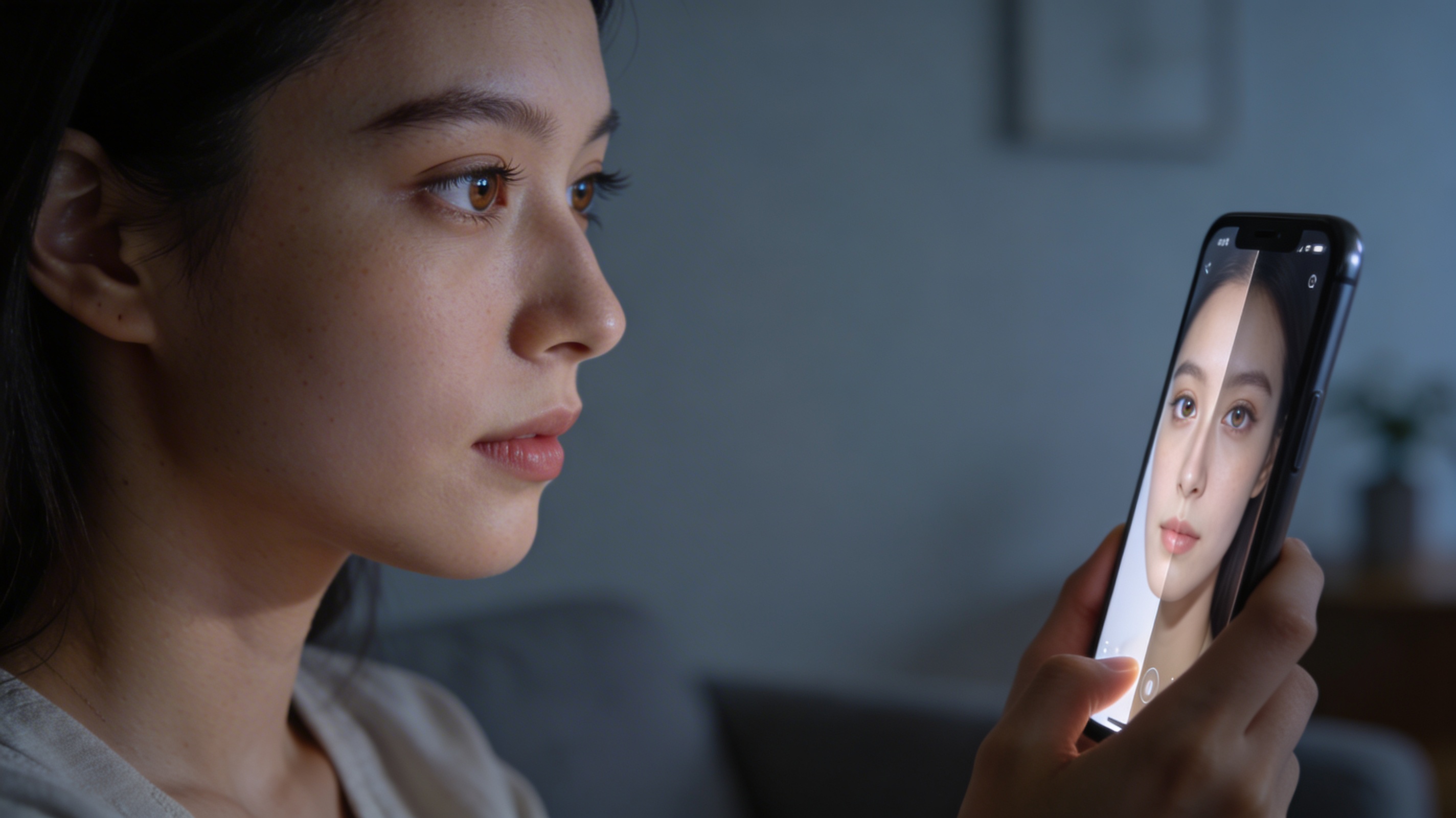
The same face. The same person. One image with a beauty filter, one without. In a 2024 study published in Royal Society Open Science, 2,748 participants rated the filtered version of that same person as more intelligent, more trustworthy, and more likely to be happy, without knowing a filter had been used at all. Your brain is assigning character traits based on pixel-level bone structure adjustments.
What the Researchers Actually Did
A team of researchers took photographs of 462 individuals, then created a second version of each image using an AI-powered beauty filter. This isn't just a skin-smoothing adjustment. The filter reshapes the nose, modifies the chin and cheekbones, adjusts the eyes and eyelashes. It's a structural transformation. Participants were randomly assigned to see either the original or the filtered version of each face, with nobody seeing the same person in both conditions. They then rated each face on intelligence, trustworthiness, sociability, and happiness on a seven-point scale.
The manipulation worked cleanly. Perceived attractiveness increased for 96.1% of all individuals after beautification. And the same people were rated significantly higher on every other trait: intelligence, trustworthiness, sociability, happiness. The face changed. Every assumption changed with it.
The Halo Effect Is Alive and Well Online
The attractiveness halo effect has been documented in psychological research for decades. When someone is perceived as physically attractive, that perception spills over into every other trait we attribute to them. Attractive defendants receive lighter court sentences. Attractive job candidates get more callbacks. Attractive students are expected to perform better academically than their actual grades warrant.
Previous research mostly relied on small, homogeneous samples. This 2024 study was large-scale and diverse, covering faces across different ages, genders, and ethnicities, rated by over 2,700 participants. The halo effect held across all of them. It doesn't matter that the transformation is artificial. The brain responds to the filtered signal and updates its assumptions as if they were real.
Then the Study Found Something Darker
Here is where the research turns uncomfortable. Beauty filters don't raise everyone's perceived attractiveness by the same amount. They help people who were originally rated as less attractive more than those who were already considered highly attractive. That compression narrows the spread of attractiveness ratings, pushing everyone toward the higher end of the scale.
When everyone looks more attractive, the halo effect for intelligence starts to break down. Beyond a certain threshold, the relationship between perceived attractiveness and perceived intelligence stops being linear. For women, it reverses. Male raters scored women as less intelligent after the beauty filter was applied than before. The filter designed to improve first impressions actually degraded perceptions of competence for women in the eyes of male raters, specifically. This was consistent, measurable, and held across a large and diverse sample. The researchers call it a saturation effect: past a certain level of attractiveness, the stereotype applied to a very attractive woman overrides the general halo. That stereotype, apparently, does not include intelligence.
Why This Matters Well Beyond Social Media
Most of us now encounter faces through screens: dating apps, LinkedIn profiles, video calls, Zoom interviews. In every one of those contexts, first impressions form in a fraction of a second from a face, often from a filtered or otherwise edited image. The research makes clear that those judgements carry real downstream weight. The face you present shapes not just how attractive someone finds you, but how capable, how trustworthy, and how worth their attention you seem, before you have said anything.
For women, the beauty filter finding has a direct implication. Pushing perceived attractiveness beyond a certain level doesn't produce more of the same benefits. It triggers a different set of assumptions, and not flattering ones when it comes to competence. That's not an argument for appearing less attractive. It's a reason to understand that the person looking at your profile is almost certainly not drawing the conclusions you intended.
What to Do With This
If you're choosing a professional profile photo, think carefully before applying a heavy beauty filter. A photo that reads as natural and high-quality captures the baseline halo effect without triggering the competence reversal that appears at extreme attractiveness levels. In professional contexts, that gap matters.
If you're making judgments about people based on digital images, whether screening job applicants or evaluating someone before a meeting, treat visual impressions as a first-pass signal, not a conclusion. Build in a deliberate checkpoint before the face influences your assessment of the person's ability. The brain is going to run the halo regardless. Knowing it's running is the only real defence against letting it run unchecked.
The next time you apply a beauty filter before posting a photo, you're not just changing how you look. You may be changing what someone decides to believe about how smart you are before they've read a single word you've written.
References
Gulati, A., Martínez-Garcia, M., Fernández, D., Lozano, M. A., Lepri, B., & Oliver, N. (2024). What is beautiful is still good: The attractiveness halo effect in the era of beauty filters. Royal Society Open Science, 11(11), 240882. https://doi.org/10.1098/rsos.240882
Share this post
Related Posts

Sharing Good News With Your Partner Matters More Than Fighting Less
A 2024 study shows how your partner responds to your good news predicts relationship quality better than how you handle conflict.

Why Getting to Know Someone Can Make You Like Them Less
A 2025 Registered Report found that familiarity can kill attraction. Here's what the science says about curiosity and why it changes everything.

The Everyday Habit That Predicts Breakups Better Than Arguments
A 2024 study secretly recorded 106 couples for a full day. Their findings on withdrawal and playfulness will change how you see your relationship.