Stop Studying One Topic at a Time: Science Has a Better Way

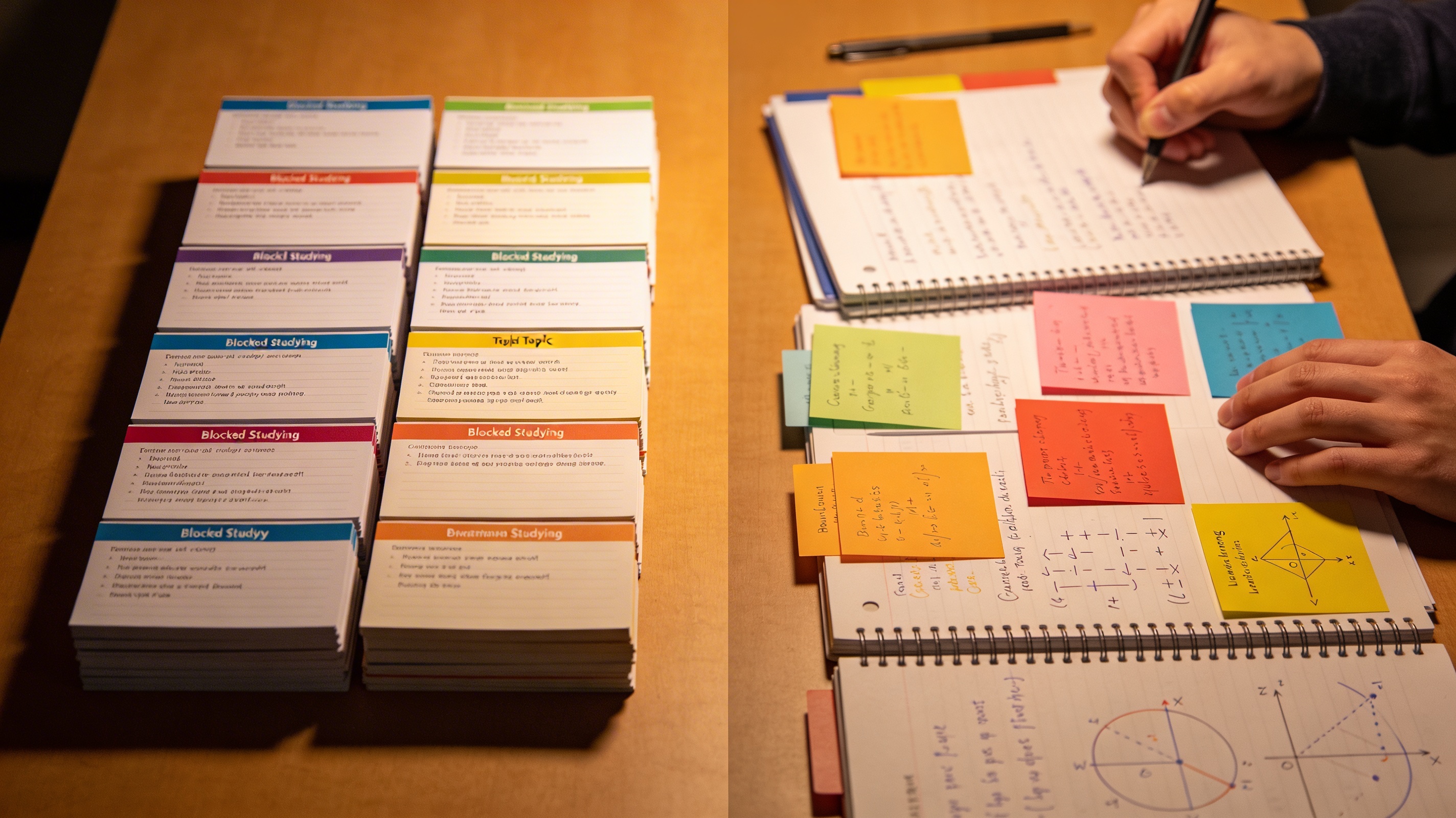
Only 22% of people can correctly identify the study method that consistently outperforms everything else. The other 78% pick the approach that feels better but delivers worse results.
That approach is called blocked practice: studying everything about one topic, finishing it, then moving to the next. It feels organized. It feels productive. It's the way most students naturally arrange their notes, their flashcards, their revision sessions. And research is clear that it is less effective than the alternative.
The Method Nobody Chooses (But Should)
The alternative is called interleaved practice: deliberately mixing different topics, subjects, or problem types within the same study session instead of grouping them together. Think studying three types of math problems within the same hour, rather than spending the full hour on just one. Cognitive scientists call the performance boost this produces the contextual interference effect, and it shows up across domains from rock classification to medical diagnosis to music to mathematics.
A 2023 study from Tufts University, published in the Journal of Intelligence, put 392 participants through a category learning task, testing whether interleaved or blocked study schedules led to better classification of confusable rock types (Do & Thomas, 2023). Interleaved practice won, cleanly, across both rule-based and information-integration learning tasks. People who interleaved were 1.6 times more likely to correctly classify a new rock exemplar than those who blocked their study. The more striking result wasn't the performance gap. It was that participants studying in an interleaved format didn't recognize they were learning more effectively — their predictions about their own test scores showed no sign of the advantage they had quietly built.
Why Everyone Keeps Getting This Wrong
This is the core problem. Interleaving feels harder. When you mix subjects or problem types, you can't ride the momentum of five similar problems in a row. You have to reconstruct context every time. You make more errors during practice. You feel confused and slow. The brain reads this difficulty as a signal that things aren't going well, and most people respond to that signal by retreating to something more comfortable.
A 2024 pre-registered study from Maastricht University, published in npj Science of Learning, examined exactly this pattern in 91 undergraduate students who were given full control over how they organized their own study materials (Onan et al., 2024). Before any intervention, students used blocked practice 57% of the time, even though they'd been told interleaving might be more effective. After an intervention combining corrective information about study methods with real-time visual feedback, use of interleaved practice jumped to 80%, and classification accuracy improved alongside it. Every single time a student switched between categories, their odds of correctly identifying a new item increased by 4 to 5%.
What's Actually Happening in Your Brain
Why does interleaving work? The leading explanation is the discriminative-contrast hypothesis: when you switch between different problem types or categories, your brain is forced to actively compare them, identify what makes each one distinct, and retrieve the relevant rules from scratch. Blocked practice never forces that comparison. You build an overfitted understanding of a concept, seeing it only in isolation, never having to contrast it against something similar. There's a memory mechanism running in parallel, too. The time gap between seeing two examples of the same concept, created naturally by interleaving other material in between, functions like a miniature version of spaced repetition. Each return to a concept after studying something else is essentially a low-stakes retrieval attempt that strengthens the memory trace in ways back-to-back repetition does not.
The practical implication is concrete: when you sit down to study, resist the urge to clear one subject before moving to the next. If you're learning vocabulary in a new language, mix word types and tenses within the same session. If you're working through math problems, rotate problem types every few questions. If you're revising multiple topics for an exam, alternate between them every 20 to 30 minutes rather than dedicating entire days to a single subject. Your practice performance will look worse in the moment. Your test performance, consistently, will not.
One Change to Make Before Your Next Study Session
The most direct starting point: take your next set of practice problems and scramble the order so that the same type never appears twice in a row. It will feel disorganized. That friction is exactly what makes it work.
The fact that most people will read this and still go back to blocking their study time is not evidence that the research is wrong. It's evidence of how difficult it is to act against an instinct that happens to feel right.
Do, L. A., & Thomas, A. K. (2023). The underappreciated benefits of interleaving for category learning. Journal of Intelligence, 11(8), 153. https://doi.org/10.3390/jintelligence11080153
Kornell, N., & Bjork, R. A. (2008). Learning concepts and categories: Is spacing the "enemy of induction"? Psychological Science, 19(6), 585–592. https://doi.org/10.1111/j.1467-9280.2008.02127.x
Onan, E., Biwer, F., Abel, R., Wiradhany, W., & de Bruin, A. (2024). Optimizing self-organized study orders: Combining refutations and metacognitive prompts improves the use of interleaved practice. npj Science of Learning, 9, 33. https://doi.org/10.1038/s41539-024-00245-7
Share this post
Related Posts

Your Laptop Is Sabotaging Your Memory. A Brain Scan Proves It.
A 2024 NTNU study found handwriting creates far more brain connectivity than typing. Here's what it means for how you learn.

Stop Reaching for Your Phone After Studying. Science Says Wait.
2025 meta-analysis confirms: 10 quiet minutes after learning boosts memory more than scrolling. Here's what the research actually says.

Why 93% of People Believe These Harmful Brain Myths
Think you know your brain? New research shows 93% believe fake neuroscience. Discover 7 myths experts still fall for, and protect your learning today.